AI is everywhere right now. And it’s moving fast.
Code can be generated in seconds. Entire applications can be scaffolded before you’ve finished your first coffee. It’s tempting to believe we’ve finally found the shortcut (the tool that replaces complexity with speed), however speed alone has rarely delivered a great outcome.
At Mojo Soup, we think about AI a little differently. Less as a replacement for human thinking and more as a powerful addition to the kitchen. Because software, like food, isn’t just about how fast it’s made. It’s about how it’s designed, who it’s for and whether it holds up when things get busy – and for that, you need Connected Brilliance.
The modern software kitchen
Today’s delivery environments look a lot like high-performance kitchens.
We have
- Cloud platforms that scale on demand
- Automation that handles repetitive prep work
- AI tools that can generate code and configurations at incredible speed
These tools are impressive. They absolutely belong in modern delivery, but none of them decide what’s being cooked.
AI can chop ingredients faster than any individjual ever could. It can even plate something that looks right, but it doesn’t understand the diners, the dietary requirements, the budget, or the fact that tonight’s service is twice as busy as usual.
That understanding still comes from people.
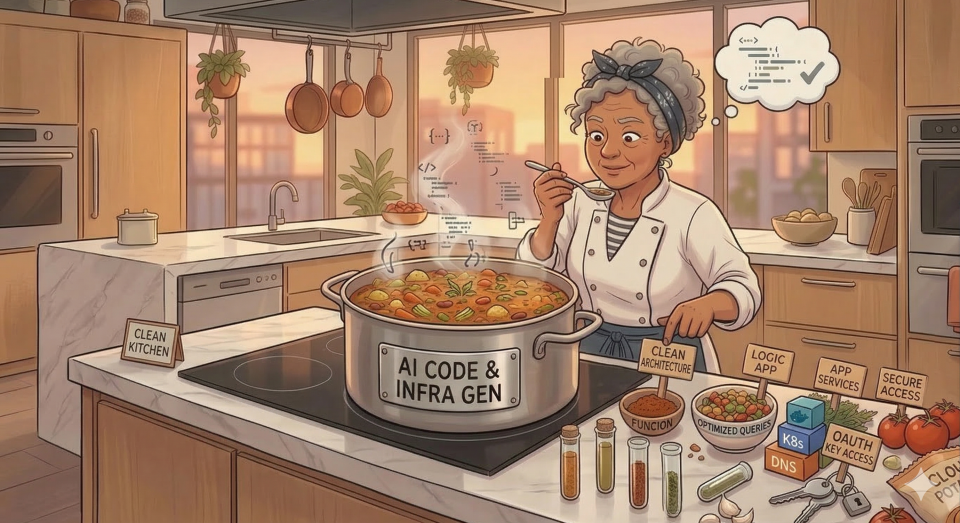
Ingredients aren’t the meal
In software, AI is exceptional at producing ingredients:
- Boilerplate code
- Utility functions
- Configuration snippets
- First drafts of logic
That’s valuable. It saves time – and reduces friction.
But ingredients scattered across a bench don’t make a meal. And randomly assembled code doesn’t make a system.
Production-ready software needs:
- Clear data flow
- Thoughtful service boundaries
- Secure access patterns
- Performance considerations
- A plan for growth and change
Those decisions aren’t about speed. They’re about intent.
AI allows teams to prototype quickly. To test ideas, explore options and surface issues before they become expensive. In the kitchen, this is the equivalent of tasting as you go. Small batches. Quick adjustments. Refining the recipe before it ever reaches the table.
Architecture is the recipe
The real craft lives in the recipe.
In software terms, that recipe is architecture (how components interact, how data moves, how failures are handled and how the system evolves over time). AI can suggest patterns. It can recall best practices. It can generate examples, but it doesn’t know:
- Which trade-offs matter for this organisation
- Where flexibility is needed versus control
- How today’s decisions affect tomorrow’s scale
That’s why experienced engineers, architects and designers still matter. They taste as they go – they adjust and understand when to follow the recipe and when to change it. At Mojo Soup, our promise of Connected Brilliance is what makes this work in real life. Our team is the blend every project needs to bring all of the ingredients to the table, and build the right recipe.
Designing for scale
One of the biggest myths in software delivery is that scalability is something you “add later”.
In a real kitchen, scale isn’t about turning the stove up. It’s about layout. Who can access which stations. How work moves without collision. What happens when twice as many orders arrive at once.
Cloud-native systems work the same way.
Scaling decisions are architectural decisions. They shape:
- How services are separated
- How data is accessed
- How identities are authenticated and authorised
- How actions are logged, traced, and audited
- How failures are isolated instead of amplified
In platforms like Azure, this shows up early, in application registrations, API permissions, identity boundaries and whether access is delegated or application-level. These choices define who can call what, and how safely and efficiently the system can grow.
AI can generate infrastructure templates and suggest permission sets. It can scaffold environments quickly but it doesn’t understand organisational risk, data sensitivity, or which systems should be trusted (and which should never talk directly).
Those decisions require intent.
Why Soup is a system
Soup might be the most underrated systems metaphor there is.
It’s made from many ingredients, simmers over time, flavours blend, deepen and improve – and the best soups are designed to evolve.
Good software works the same way.
At Mojo Soup, we design systems that are grown and nurtured. Through Connected Brilliance, we bring together people, processes and digital solutions so that our solutions adapt, scale and thrive long after go-live.
That’s why discovery, design, testing, optimisation, and hypercare matter in our business. A rushed dish might look fine on day one but we know from experience, that a well-designed one holds firm under real demand.
AI with taste
Of course, we use AI to add value:
- Accelerating delivery
- Reducing repetitive effort
- Supporting exploration and ideation
Human first, technician second
Our approach is always human first. Matching the right team, tools and technology to turn your ideas into systems people can actually run. One size never fits all, and no model understands your organisation the way your people do – for us that’s where the magic happens.
Final thought
Great software isn’t assembled, it’s cooked, nurtured, shared, enjoyed and often better when it’s left for longer.
Just like food, the difference between something that works and something that lasts comes down to taste, timing and care.
At Mojo Soup, that’s the Connected Brilliance we bring to every engagement.