
“It’s still working.” Famous last words.
Imagine you run a busy restaurant with an oven that’s been turning out perfectly good meals for twenty years.
The thermostat has a mind of its own, one burner needs encouragement, and the chef knows to rotate everything halfway through cooking because the back corner runs hotter than the rest.
You’ve considered replacing it, but a new commercial oven is expensive, your staff know its peculiarities, and there are plenty of other things competing for your money. Besides, there’s a local technician who’s been servicing that model for years.
Then, one Friday afternoon, the oven gives up.
You ring the technician and discover he’s retired. The manufacturer stopped making replacement parts years ago, and the only other specialist anyone can recommend is booked out for six weeks. His rates are eye-watering, and he can’t even guarantee he’ll find the parts.
Meanwhile, you’ve got a restaurant full of bookings and a kitchen that can’t do its job.
The oven hasn’t become any more valuable. You’ve simply run out of affordable ways to keep it working.
Sound familiar?
The disappearing art of keeping old technology alive
Most organisations have at least one system everyone quietly (or not so quietly) agrees not to interfere with.
It might be a finance application, scheduling platform or database built fifteen years ago by a developer nobody remembers. People know how to use it, it does what the business needs, and replacing it would involve procurement, migration, integrations and considerable disruption.
Keeping it makes sense, particularly when there are more pressing investments.
But as technology ages, the market of people who understand it shrinks. Experienced specialists retire, new developers learn contemporary platforms, and vendors focus on products they’re actively developing.
Eventually, you might depend on a handful of people to maintain something your entire organisation relies on. With fewer specialists available, you have less choice over who does the work, how quickly they can do it and what they’ll charge.
Then there’s the software equivalent of replacement parts: databases, operating systems, integrations and infrastructure that eventually reach the end of vendor support.
Cybersecurity adds another complication. New vulnerabilities emerge, threats evolve, and older platforms become harder to secure when updates are no longer available. A system that passed a security assessment two years ago isn’t necessarily in the same position today.
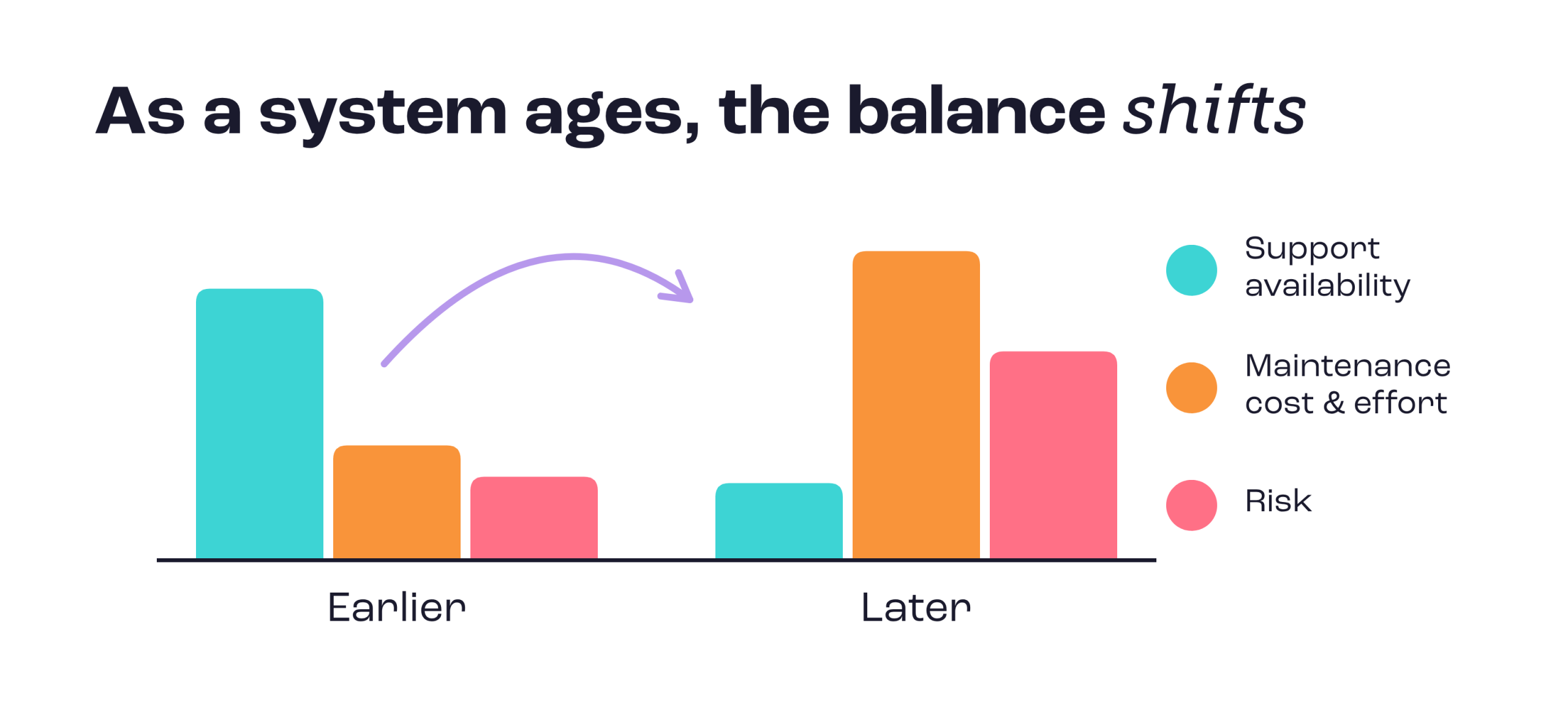
A system’s reliability over the past decade tells you surprisingly little about how easy it will be to maintain over the next three years.
Now you’re paying for two kitchens
Back at our restaurant, the owner has accepted that it’s time for a replacement.
Unfortunately, choosing and installing commercial equipment takes time, particularly when it involves new ventilation, electrical work and changes to the kitchen layout.
The restaurant can’t stop serving meals for months, so the owner is paying a specialist to keep the old oven running while funding its replacement.
Organisations with ageing technology face exactly the same problem.
Replacing a business-critical application can take years once you account for procurement, implementation, migration, testing and business change.
Throughout that process, the existing system still needs hosting, licensing, specialist support and security maintenance.
You’re paying to maintain the past while building the future.
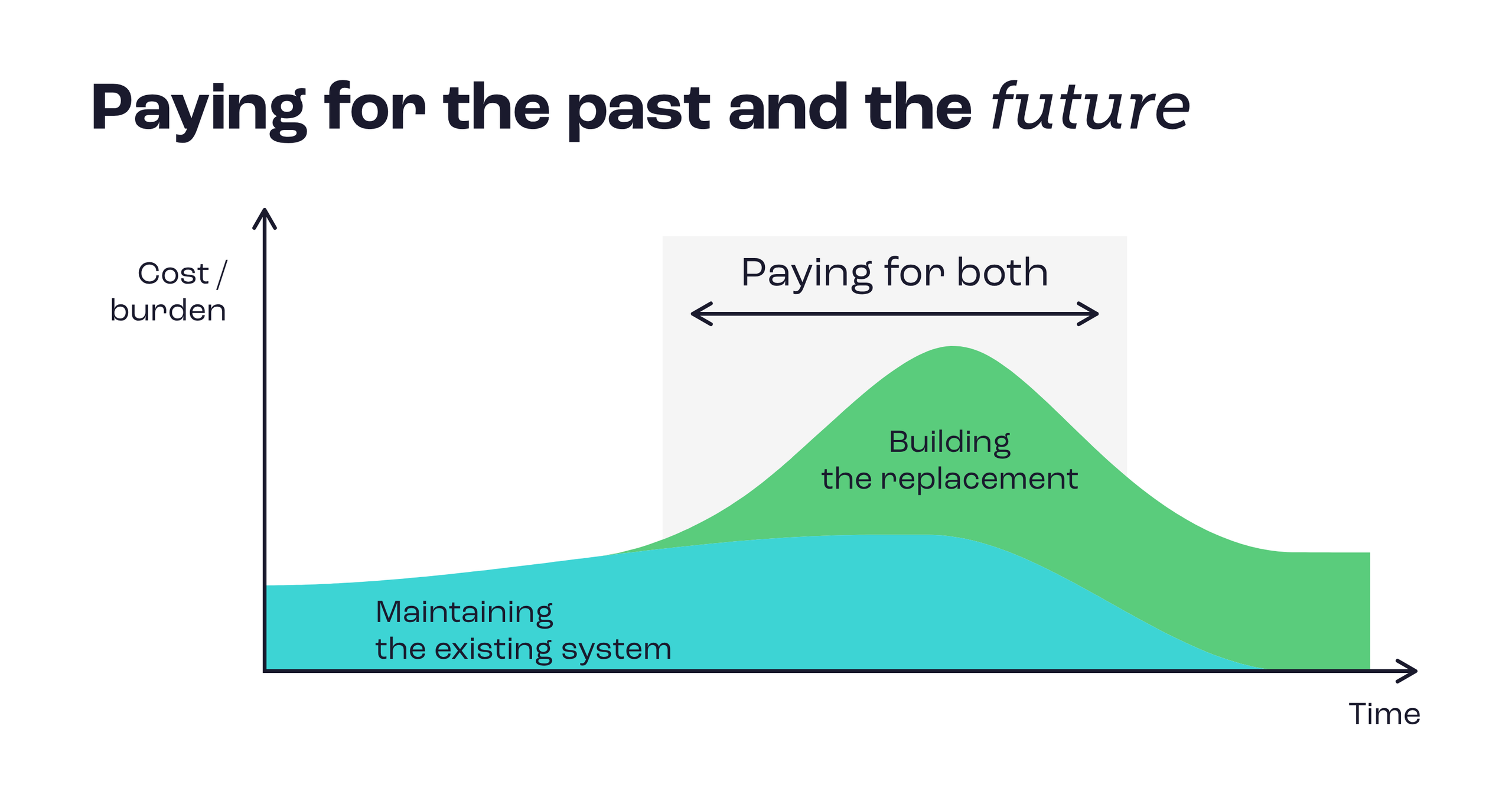
Some overlap is unavoidable, but it becomes particularly painful when maintaining the old environment has grown unexpectedly expensive.
And if your executive team struggled to justify replacing a functioning system in the first place, imagine asking them for additional funding to extend its life before replacing it anyway.
That’s a considerably harder business case to sell.
We recently helped a Customer travel back to 2013
Sometimes an organisation simply doesn’t have enough time to replace a system before an important deadline arrives.
We encountered this recently when an established project management platform was approaching retirement. Hundreds of people relied on it for scheduling, resource planning and reporting, and introducing an entirely different solution would have required significant evaluation, migration, training and business change.
The deadline wasn’t moving, so we helped the customer take an unexpected trip back to the future.
Think 2013, when Daft Punk’s Get Lucky was everywhere, everyone was doing the Harlem Shake, and the iPhone 5s was the latest thing.
Rather than rushing a wholesale transformation, we helped the organisation adopt Microsoft Project Server Subscription Edition, a supported platform built around an older, familiar approach to enterprise project management.
Our application specialists worked alongside the Customer’s internal teams, while our Connected Brilliance partner, BITS Technology Group, provided infrastructure and hosting expertise. Together, we tackled the challenges of securely connecting users to an externally hosted environment while preserving the functionality they depended on.
The result was continuity for hundreds of users, minimal disruption and approximately three years of breathing room to plan a longer-term transformation.
Would we have recommended this approach with unlimited time to evaluate the options? Probably not.
But that wasn’t the situation the Customer faced, and maintaining an essential capability was more important than introducing something entirely new.
It was the right solution to the immediate problem, even though implementing and supporting an interim platform involves costs that wouldn’t exist in an ideal, carefully planned transition.
How do you sell modernisation when nobody thinks it’s urgent?
If you’re trying to secure funding to update an ageing system, the strongest argument probably isn’t that the technology is old.
It’s demonstrating what the organisation is depending on and what could happen if those dependencies disappear.
Five questions can help make that case:
- Who can still fix it? How many specialists genuinely understand the platform, and what happens if they’re unavailable?
- Can we still get the parts? Which software components, vendors and integrations does it depend on, and how long will they remain supported?
- What will it cost to keep running? Consider specialist support, infrastructure, licensing and security maintenance over the next few years.
- How long would replacement actually take? Include procurement, migration, integration, testing and business change.
- What happens if we’re forced to act sooner? Could the organisation maintain operations while a replacement is delivered?
The answers give executives a clearer comparison between the cost of planned modernisation and the potential expense of maintaining the existing system under pressure.
You might still decide to keep the current platform for several more years, and that could be entirely sensible. The important thing is knowing what you’re committing to.
Sometimes you need someone who knows their way around an old oven!
That’s where we come in. We’ve been doing this for over 17 years!
At Mojo Soup, we help organisations modernise ageing applications, replace platforms that have reached the end of their useful life and extend the life of systems they still depend on.
Our Microsoft technology expertise and Connected Brilliance partner network mean we can bring together the right capabilities when an organisation needs specialist application, infrastructure, hosting or security support.
Sometimes we’ll recommend a whole new kitchen, and other times we’ll find a practical way to keep the existing one operating while you plan what comes next.
We’d just rather have that conversation before the Friday night dinner rush.
Got an ageing system you’re wondering what to do with?
Whether you’re planning a replacement, struggling to find specialist support or facing an approaching deadline, Mojo Soup can help you understand your options and make a practical plan.
Let’s have a chat before you’re forced to close the kitchen!