
By Madison Steele
The Brisbane 2032 Olympics will create some of the most visible, high-pressure delivery work Queensland Government has undertaken in years.
There will be major infrastructure programs, new digital services, changes in demand, cross-agency projects and a very public deadline. For the people involved, it will also be a rare opportunity to work on something that has genuine statewide significance.
I’m Madison Steele, a Senior Technical Business Analyst and Microsoft 365 Consultant at Mojo Soup. I work across private and government organisations, helping customers solve both business and technical problems, often sitting in the space between requirements, process, technology and the people who need to make all of those things work together.
Queensland already has significant coordination structures in place for Brisbane 2032. But from the perspective of someone working inside delivery teams, there is another capability I think will matter enormously as 2032 gets closer.
It is knowing who to call.
It sounds simple, but in government delivery it can make an enormous difference. Projects rarely operate neatly inside one team. The people who own the business process might sit somewhere different from the people who own the data, who might sit somewhere different again from the people responsible for the technology, approvals or infrastructure.
That already creates complexity today. By 2032, when more projects are crossing organisational boundaries and more dependencies are converging around the same deadline, it will matter even more.
The Olympics will create a dependency problem
Some of the most difficult project issues I’ve encountered have had very little to do with the technology itself.
I’ve worked on projects where one group needed a solution, another group owned the data required to make it work, and there was no clear agreement between them about ownership or where the solution should ultimately live. Both sides had legitimate responsibilities, but because those questions had not been resolved early enough, the project became stuck.
That is exactly the kind of issue I would want to identify long before a 2032 deadline.
For any significant cross-agency initiative, I would get the right people into the same room during planning and design and work through the dependencies early. Who owns what? Which teams will eventually need to be involved? What approvals will be required? Where does the solution need to live? What could become a showstopper later?
The closer a project gets to delivery, the more expensive those unresolved questions become.
Knowing who to call should be a delivery capability
One of the best experiences I’ve had navigating a complicated government project involved an IT contact who didn’t personally have every answer.
What made him valuable was that he knew the organisation.
If something belonged with cloud services, he knew who to speak to. If we needed a particular permission, he knew which team managed it. Rather than lodging a support request, waiting for it to be interpreted, getting redirected and starting again, we could get to the right conversation quickly.
That organisational knowledge saved an extraordinary amount of time.
It also made me realise how difficult government can be to navigate when you only have job titles and organisational charts to work from. The person responsible for a particular system or process may have a title that gives you no indication that they are the person you actually need.
By the time the Brisbane 2032 Olympics arrive, I would love to see project teams have much better visibility of who owns what, who knows what and where to go when a dependency crosses organisational boundaries.
That could mean clearer responsibility mapping, stronger links between project managers and internal technology teams, or giving major programs access to people who can help navigate the organisation and connect teams to the right specialists.
Whatever the mechanism, the outcome should be the same: when something gets stuck, people know where to go next.
Build the relationships before the pressure arrives
Relationship management is sometimes treated as the softer side of project delivery, but in my experience it is often what determines whether delivery keeps moving.
I’ve seen technically sound projects create unnecessary anxiety because the project team, subject matter experts and end users were not communicating well enough. People knew change was coming, but they didn’t understand what it meant for them, so uncertainty started creating resistance around a solution that was far less disruptive than they feared.
At that point, the problem is no longer technical. It becomes a relationship problem.
This matters enormously for 2032 because many teams and agencies will need to collaborate more closely than they do today. Formal coordination structures can help create the conditions for that collaboration, but project teams still need working relationships at the level where delivery actually happens.
If those relationships only begin when an urgent dependency appears, valuable time will already have been lost.
Six years gives government the opportunity to keep building those connections now.
Give 2032 teams a common delivery language
The other thing I think our future selves would thank us for is greater consistency in how projects are delivered.
It doesn’t mean every project needs to operate identically. Different projects need flexibility around scope, capacity and approach. What should be more consistent are the fundamentals: how dependencies are identified, when users are involved, how testing works, how status is communicated and what different delivery stages actually mean.
If teams across government share that language, collaboration becomes much easier. When one agency tells another where a project is up to, both sides understand what that means. When people move between projects, they don’t have to relearn the basics every time.
It also creates a stronger foundation for testing and learning early, which will be essential when preparing for requirements that cannot realistically be predicted six years in advance.
What will your 2032 self thank you for?
There will be plenty of shiny things built for the Brisbane 2032 Olympics, and many of them will be necessary.
But some of the most valuable work we can do today is much less glamorous.
Things like building relationships, making ownership and dependencies visible, and agreeing on how projects will be delivered. Above all – let’s make it easier for people to navigate the organisation.
If we get those things right now, the benefits will extend well beyond the Games.
And when the pressure really arrives in 2032, the people delivering Queensland’s biggest programs won’t be starting from scratch because they’ll already know how to work together, how to move through the organisation and, most importantly, who to call.
Want to keep the conversation going?
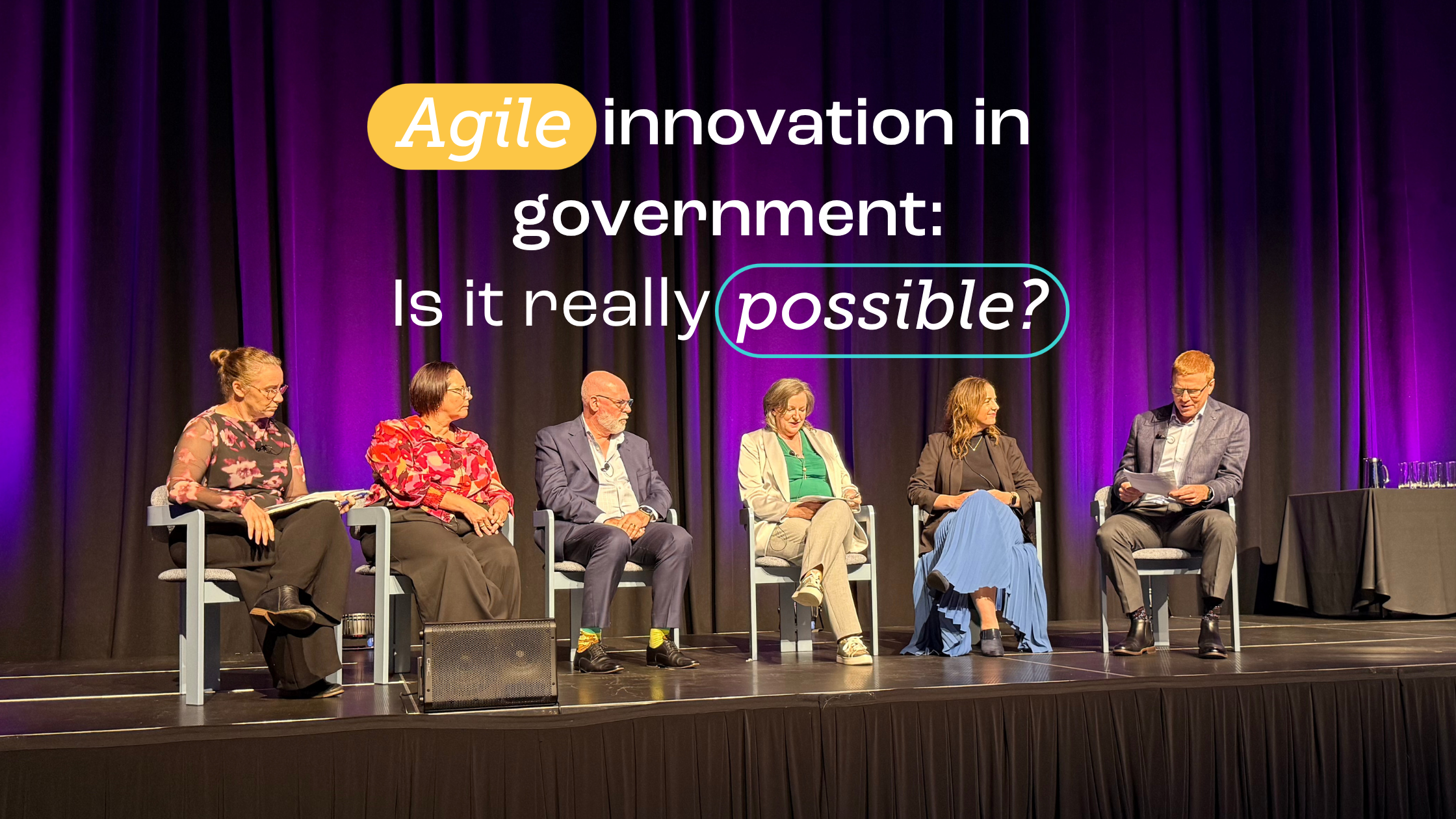
Mojo Soup CEO Dave Lockie will be exploring what it really takes to make agile delivery work inside government at the Government Innovation Showcase, on the panel “Agile Innovation in Government: Is It Really Possible?”
If Brisbane 2032 is going to test how well government can work across teams, agencies and delivery structures, this is exactly the conversation we need to be having now.