
By David Lockie
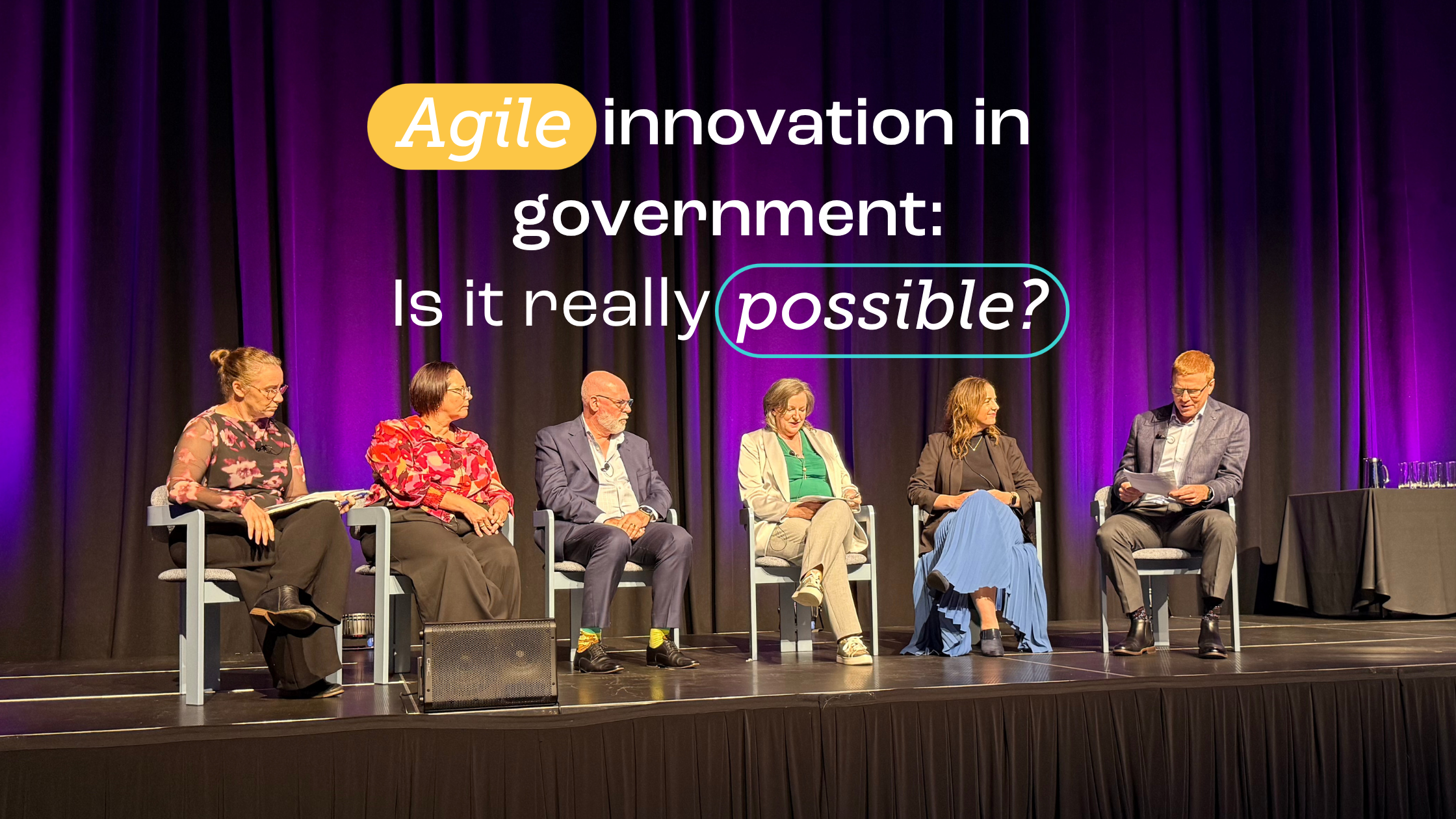
At the Government Innovation Showcase last week, my job was to moderate a panel on Agile Innovation in Government: Is It Really Possible?
And to be clear, the room was there to hear from the panellists, not me!
I had a pretty formidable group to keep the conversation moving between:
- Jeremy Janes, Chief Digital Officer, Queensland Rural and Industry Development Authority
- Lauren Poynting, Executive Director, Department of the Environment, Tourism, Science and Innovation
- Vanessa Douglas-Savage, Branch Manager, Australian Government Architecture and Policy, Digital Transformation Agency
- Georgina Crundell, Assistant Auditor-General for Technology Audit at QAO, Queensland Audit Office
- Pia Andrews, General Manager, Corporate and Enabling Services, Department of Children and Families.
Between them, it’s an extraordinary breadth of experience across digital, policy, assurance, frontline services, leadership and the machinery of government. But it’s also a topic I’m passionate about, and when you get a group of smart people together talking about something you spend a lot of time thinking about, it’s hard not to walk away with a few thoughts of your own.
So in case you missed it, or want to deep dive – here are the key takeaways from the panel discussion and my thoughts about it. We talked about disaster response, delegated authority, risk, leadership, assurance, operating models and even platypuses. But one comment from Pia neatly turned our original question on its head:
“Of course it’s possible. We do it in emergencies. We do it all the time.”
And she’s right. Government already proves it can move quickly. Lauren brought that to life through her experience with Queensland Fire and Emergency Services, including disaster response and Triple Zero operations.
In those environments, there isn’t always the luxury of waiting for perfect conditions. You adapt to the person, the situation and the information in front of you while still working towards a very clear outcome. Her conclusion was simple:
“People are your biggest tool to unlocking innovation.”
So maybe the more useful question is not whether government can be agile, but what makes agility possible – and how we create more of those conditions when there isn’t a crisis forcing us to.
The outcome can be fixed, even when the path isn’t
One of the tensions I wanted to explore was the apparent conflict between agility and certainty. Government quite reasonably wants clear outcomes, accountability and confidence that public money is being spent well. But that can easily become an assumption that every step also needs to be decided in advance. Vanessa challenged that.
“Keep your North Star and have an agreement on it, but there are always multiple ways of doing things.”
A fixed outcome does not require a fixed route. The discipline is in staying accountable to what you are trying to achieve, while retaining the ability to change how you get there as new information emerges.
An agile delivery team can’t do it alone
Jeremy made another important point:
“You can’t drive agile outcomes just from a technology or delivery-only perspective.”
A delivery team can work iteratively and respond quickly, but if funding, procurement, approval and assurance processes around them operate on a completely different cadence, there is a limit to how agile they can really be.
Agility therefore needs to extend into the broader operating model, not just the delivery team. Eventually, even the best team runs into the walls around it.
Agility needs delegated authority
Pia pushed that further. She used military hierarchy as an example, arguing that effective hierarchy is not about less governance. It is about:
“Exactly the right amount of decision-making at every level.”
Her warning was sharper:
“Agile without the delegation ends up just like running faster off a cliff.”
That line stayed with me because speed on its own is not the objective. People need enough authority to make appropriate decisions close to the work, while remaining accountable to a clear outcome.
Pia also put it neatly from a leadership perspective:
“Mature executives are not just confident to delegate authority, they’re confident to exercise their authority.”
That combination matters. There is no prize for being the most Agile organisation. The objective is better public outcomes.
Pia picked up the same idea from a different angle, distinguishing capital-A Agile as a methodology from something broader:
“There’s also something important about striving for systemic institutional agility.”
Her point was that institutions need to be able to detect change, understand whether they are having the intended impact, identify unintended consequences and respond. That feels like a much more useful ambition than simply trying to make more projects “Agile”.
Assurance should actually assure something
The discussion on assurance was probably the part I found most practically useful. Georgina was clear:
“Just because you’re agile doesn’t mean no documentation.”
But there is a significant difference between documentation and assurance. Pia shared an example from Canada where a relatively small public-facing website had to navigate 52 steps, 13 authorities and nine signature blocks, generating around 40,000 words of documentation for a 4,000-word website. Her assessment was blunt:
“Assurance is a documentation exercise and it doesn’t assure anything.”
The issue wasn’t that assurance existed. It was that the process had become so cumbersome that the organisation’s ability to release anything new had itself become a risk. Pia argued for moving from compliance-based assurance towards “test-driven assurance” – focusing on whether we are actually assuring the right things.
Georgina added that good assurance only has value if organisations act on what they learn. The value of assurance isn’t the existence of the report – it’s what changes because of it.
Sometimes people need to see the platypus
Pia also gave us the most memorable metaphor of the day. When the platypus was first described to people in England, they reportedly thought someone had simply stitched several animals together. It was only when they saw the real thing live that they believed it was a real animal. Her point:
“Until you see it real and working… only then can you believe it.”
Sometimes another strategy paper is not what changes somebody’s mind. A small experiment can. A prototype can. A real example of something working can.
Once people have seen a better way, it becomes much harder to argue the old way is the only way.
Government has already proved the premise
Which brings me back to Pia’s closing challenge. Can government innovate?
“We all know it’s possible.”
It proves it every time circumstances demand it.
The opportunity now is to understand what makes that possible: clear outcomes, delegated authority, leadership, responsive operating models, meaningful assurance and room to learn. Then create more of those conditions before a crisis makes them unavoidable.
Did something in this discussion spark an idea for how your department could work differently? Maybe there’s a project that’s been difficult to get moving, a process that could be more adaptive, or an opportunity to test a different way of delivering. If you’re exploring how to make that happen, we’d be happy to talk it through with you.
Did you miss the panel or want to make some notes? If you’d like a copy of the full transcript, click here to email Lucy and she’ll send it through.